

What COMISA Is, Why It Matters, and How Common It Is
COMISA (Co-Morbid Insomnia and Sleep Apnea) is a “double-jeopardy” condition frequently seen in sleep clinics but largely unknown to the general public. Once considered entirely separate disorders, obstructive sleep apnea (OSA) and insomnia are now recognized as deeply intertwined.
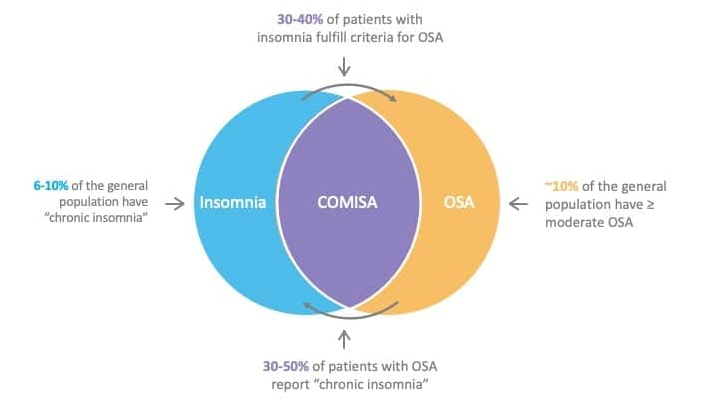
Patients with COMISA often experience severe difficulties initiating or maintaining sleep, early morning awakenings, non-restorative sleep, daytime fatigue, and impaired concentration. These compounded symptoms frequently diminish their quality of life far more than either condition would in isolation Figure from Sweetman et al. 2021(1)

Figure from Sweetman et al. 2021(1)
2. Global Prevalence
COMISA is far from a rare clinical curiosity. Systematic reviews and meta-analyses highlight its widespread impact:
- 30–50% of patients with OSA meet the diagnostic criteria for chronic insomnia.
- 30–40% of patients with chronic insomnia have undiagnosed OSA (AHI ≥ 5/h).
- 30–50 million adults globally are estimated to suffer from COMISA.
3. Clinical Implications by COMISA
COMISA is not simply “two diseases in one patient”—it is a distinct clinical phenotype with a bidirectional pathophysiology. Arousals from apneas fragment sleep and perpetuate hyperarousal, while insomnia-driven sleep fragmentation destabilizes upper airway control. This compounding effect leads to significantly worse outcomes(2):
- Cardiovascular morbidity: Elevated risk of hypertension, atrial fibrillation, and coronary events beyond that conferred by OSA alone.
- All-cause mortality : A landmark analysis of the Sleep Heart Health Study demonstrated a 47% increased mortality risk in COMISA patients over 15 years compared to controls.
- Neurocognitive and mental health burden : Higher rates of depression, anxiety, suicidal ideation, and an increased risk of dementia(3)
- Treatment resistance : CPAP adherence significantly is reduced — the insomnia component undermines the very therapy meant to correct the apnea.
4. Current Diagnostic Challenges
Diagnosing COMISA is inherently complex because the symptoms often mimic one another. An OSA patient’s frequent awakenings may sound clinically similar to insomnia’s sleep maintenance issues. Accurate diagnosis currently requires a multidisciplinary approach:(4)
Clinical Interviews & Sleep Diaries: Insomnia diagnoses rely heavily on clinical evaluations, validated questionnaires, and prospective sleep logs. However, these depend on patient-recalled subjective symptoms, making them highly susceptible to recall bias. (5)
Polysomnography (PSG): While an overnight in-lab sleep study is the gold standard for measuring the Apnea-Hypopnea Index (AHI), a single night cannot capture the full spectrum of insomnia symptoms due to night-to-night variability. Consequently, PSG is not recommended as a primary diagnostic tool for insomnia, creating a major hurdle for identifying COMISA. (6)
Actigraphy: Used for multi-night tracking, actigraphy bridges the gap between subjective diaries and single-night PSG by objectively monitoring sleep-wake patterns.
5. How Belun® Ring Transforms Diagnosis & Monitoring
We are moving away from relying entirely on cumbersome, in-lab polysomnography toward advanced digital phenotyping. Because one-night PSG is insufficient to capture insomnia, innovations in multi-night monitoring (e.g. advanced wearables)—are critical. Technologies like the Belun® Ring track both sleep-disordered breathing and sleep duration simultaneously over weeks, rather than hours. This longitudinal data captures the reality of a patient’s sleep in their own bed, eliminating the high costs and “first-night effect” of an unfamiliar lab while providing an objective, multi-night recording to traditional sleep diaries.
6. Fresh off the Press : Newest Study in Nature’s Scientific Reports
We are thrilled to share our newly published feasibility study in Scientific Reports:
A wearable-based pathway for characterizing COMISA, Insomnia, and OSA.
Deployed in a Hong Kong community hospital, the Belun® Ring successfully characterized these conditions outside of a traditional sleep center. We discovered that COMISA and insomnia patients exhibited notably longer sleep onset latency and greater wake-after-sleep-onset (WASO) times than those with OSA alone, while OSA-alone and COMISA patients showed higher AHI metrics than those with insomnia-alone (Figure: Young et al., 2026) (7).

This demonstrates that multi-night wearable monitoring effectively complements traditional clinical phenotyping. By serving as an accurate early triage tool, we successfully optimized Hong Kong’s public healthcare pathway, massively reducing patient wait times from 104 weeks down to an impressive 45 weeks.
Sleep medicine is entering an exciting, multidisciplinary era. Let’s start treating the whole patient, not just the apnea or the insomnia.
Reference:
1. Sweetman A, Lack L, McEvoy RD, Smith S, Eckert DJ, Osman A, et al. Bi-directional relationships between co-morbid insomnia and sleep apnea (COMISA). Sleep Med Rev. 2021 Dec 1;60:101519. doi:10.1016/j.smrv.2021.101519
2. Popovici C, Steiropoulos P, Mihaicuta S, Dumitru S, Dragila S, Bikov A, et al. The Hidden Burden of COMISA: Clinical Implications and Treatment Challenges. Pulm Ther. 2026 Mar;12(1):25–38. doi:10.1007/s41030-025-00331-0
3. Dementia Risk in Patients with Comorbid Insomnia and Obstructive Sleep Apnea: A Propensity Score–Matched Cohort Study | SLEEP | Oxford Academic [Internet]. [cited 2026 Sep 14]. Available from: https://academic.oup.com/sleep/advance-article-abstract/doi/10.1093/sleep/zsag224/8770613
4. Ragnoli B, Pochetti P, Raie A, Malerba M. Comorbid Insomnia and Obstructive Sleep Apnea (COMISA): Current Concepts of Patient Management. Int J Environ Res Public Health. 2021 Sep 1;18(17):9248. doi:10.3390/ijerph18179248
5. Ong JC, Crawford MR, Wallace DM. Sleep Apnea and Insomnia. Chest. 2021 May;159(5):2020–8. doi:10.1016/j.chest.2020.12.002
6. Wulterkens BM, Den Teuling NGP, Hermans LWA, Asin J, Duis N, Overeem S, et al. Multi-night home assessment of sleep structure in OSA with and without insomnia. Sleep Med. 2024 May;117:152–61. doi:10.1016/j.sleep.2024.03.031
7. Young BHK, Kwok ICY, Tsai CW, Leung L, Cheung C, Kwok APL. A wearable-based pathway for characterizing COMISA, insomnia, and OSA: a feasibility study in a community hospital. Sci Rep. 2026.
8. Selected Sleep Review Article: COMISA Impacts a Third of People with Insomnia or OSA. A Sleep Researcher Explains Why That Matters
Leave a Reply