

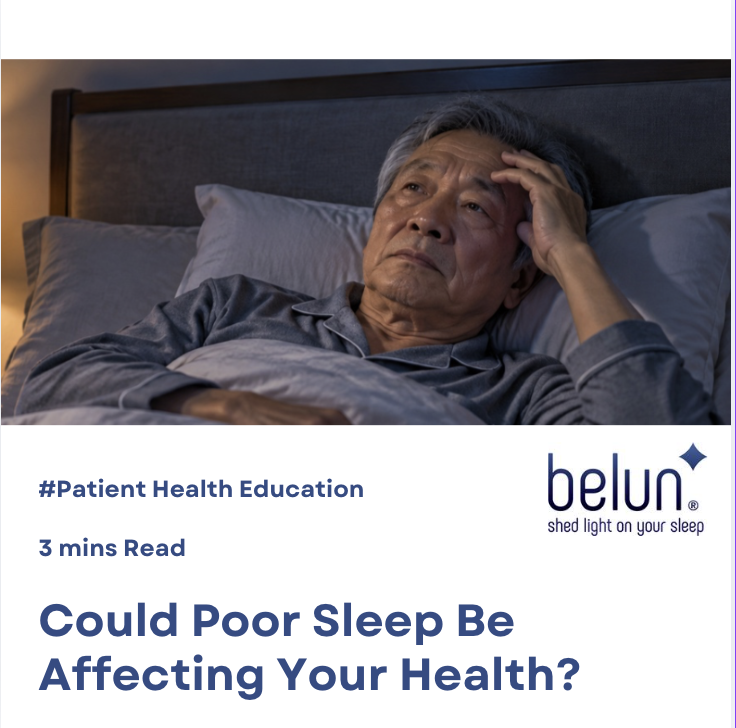
Are You Sleeping Well ?
You eat healthily, try to stay active and take your prescribed medications. But have you considered whether your sleep could be affecting your health?

Many people focus on diet and exercise when managing their health, yet overlook another essential factor: sleep.
Sleep is more than just rest. It plays an important role in regulating blood pressure, blood sugar, metabolism and brain health. Research shows that consistently poor sleep is associated with an increased risk of several chronic health conditions.
1. Could Poor Sleep Be Affecting Your Health ?
You may be surprised by how closely sleep is connected to your overall health.

If you are managing diabetes, high blood pressure or weight problems, paying attention to your sleep may be another important step toward better health.
2. Sleeping 8 Hours But Still Feeling Tired?
Most adults need around 7–9 hours of sleep each night. However, getting enough hours does not always mean getting good-quality sleep.
You might spend eight hours in bed but still wake up feeling exhausted. One possible reason is obstructive sleep apnea (OSA), a condition where breathing repeatedly becomes blocked or restricted during sleep.
These breathing interruptions can disturb your sleep, sometimes without you realizing it. Sleep apnea is also associated with high blood pressure, cardiovascular disease and type 2 diabetes.
3. 5 Signs Your Sleep May Need Attention
Do any of these sound familiar?
- You snore loudly or frequently.
- You experience frequent awakenings during the night.
- You wake up gasping for air or have breathing pauses noticed by someone else.
- You feel mouth dry when you wake up.
- You often feel sleepy, unfocused or exhausted during the day despite sleeping enough.
These symptoms do not necessarily mean you have sleep apnea, but they may indicate that your sleep deserves further attention.
4. What Can You Do To Improve Your Sleep
Maintain a regular sleep schedule: Go to bed and wake up at similar times each day.
• Create a sleep-friendly environment: Keep your bedroom cool, dark and quiet.
• Limit caffeine and screen time: Avoid caffeine late in the day and reduce stimulating activities before bedtime.
• Pay attention to persistent symptoms: Do not ignore ongoing fatigue, snoring or disrupted sleep.
If your sleep problems continue, speak with your GP. Your doctor can help assess possible causes and determine whether further sleep testing is appropriate.
Better Sleep, Better Health
Taking care of your sleep is just as important as eating well, exercising and attending regular health checks. If you are managing high blood pressure, diabetes or weight concerns, your sleep health may be another piece of the puzzle.
The next time you visit your family doctor, don’t forget to talk about your sleep. Understanding how well you sleep could be an important step toward improving your overall health.
This article is for general health education and does not replace professional medical advice.
Continued Reading :
See our previous story about CBT-I to understand how Belun’s applications would help clinical psychologists.
REFERENCE:
1. Grandner MA. Sleep, Health, and Society. Sleep Med Clin. 2017;12(1):1–22.
2. St-Onge M-P, et al. Multidimensional Sleep Health: Definitions and Implications for Cardiometabolic Health. AHA. 2025.
3. Gottesman RF, et al. Impact of Sleep Disorders and Disturbed Sleep on Brain Health. Stroke. 2024.
4. Shah AS, et al. Effects of Sleep Deprivation on Physical and Mental Health Outcomes: An Umbrella Review. Am J Lifestyle Med. 2025.
Publications by Belun :
1) “Belun® Ring Platform: a novel home sleep apnea testing system for assessment of obstructive sleep apnea” (https://jcsm.aasm.org/doi/10.5664/jcsm.8592),
2) “Detection of obstructive sleep apnea using Belun® Sleep Platform wearable with neural network based algorithm and its combined use with STOP-Bang questionnaire” (https://journals.plos.org/plosone/article?id=10.1371/journal.pone.0258040),
3) “Belun® Ring (Belun® Sleep System BLS-100): Deep Learning-Facilitated Wearable Enables OSA Detection, Apnea Severity Categorization, and Sleep Stage Classification in Patients Suspected of OSA” (https://pubmed.ncbi.nlm.nih.gov/37380590/),
4) “Correlation of Pulse Rate Variability(PRV) and Heart Rate Variability(HRV) Metrics During Sleep in Subjects Suspected of OSA” (https://academic.oup.com/sleep/article/46/Supplement_1/A420/7182347)
5) “The Belun sleep platform to diagnose obstructive sleep apnea in patients with hypertension and high cardiovascular risk” (https://pubmed.ncbi.nlm.nih.gov/37071415/)
6) “Integrating Body Sensor into a Wearable Platform to Enhance the Identification of Central and Mixed Apneas”. (https://academic.oup.com/sleep/article/47/Supplement_1/A222/7654683)
7) “Using a Wearable’s Multi-Night Capability to Mitigate Night-to-Night Variability in a Dental Clinic Cohort”. J Dental Sleep Med. 2026; 13(1). (https://aadsm.org/journal/original_article_1_issue_131.php)
Partnering with Belun :
If you would like to know more about how to adopt Belun’s solution in your organization, please feel free to contact us to schedule a meeting by filling out the form below:

